
Machine Learning
Training assessment complete.
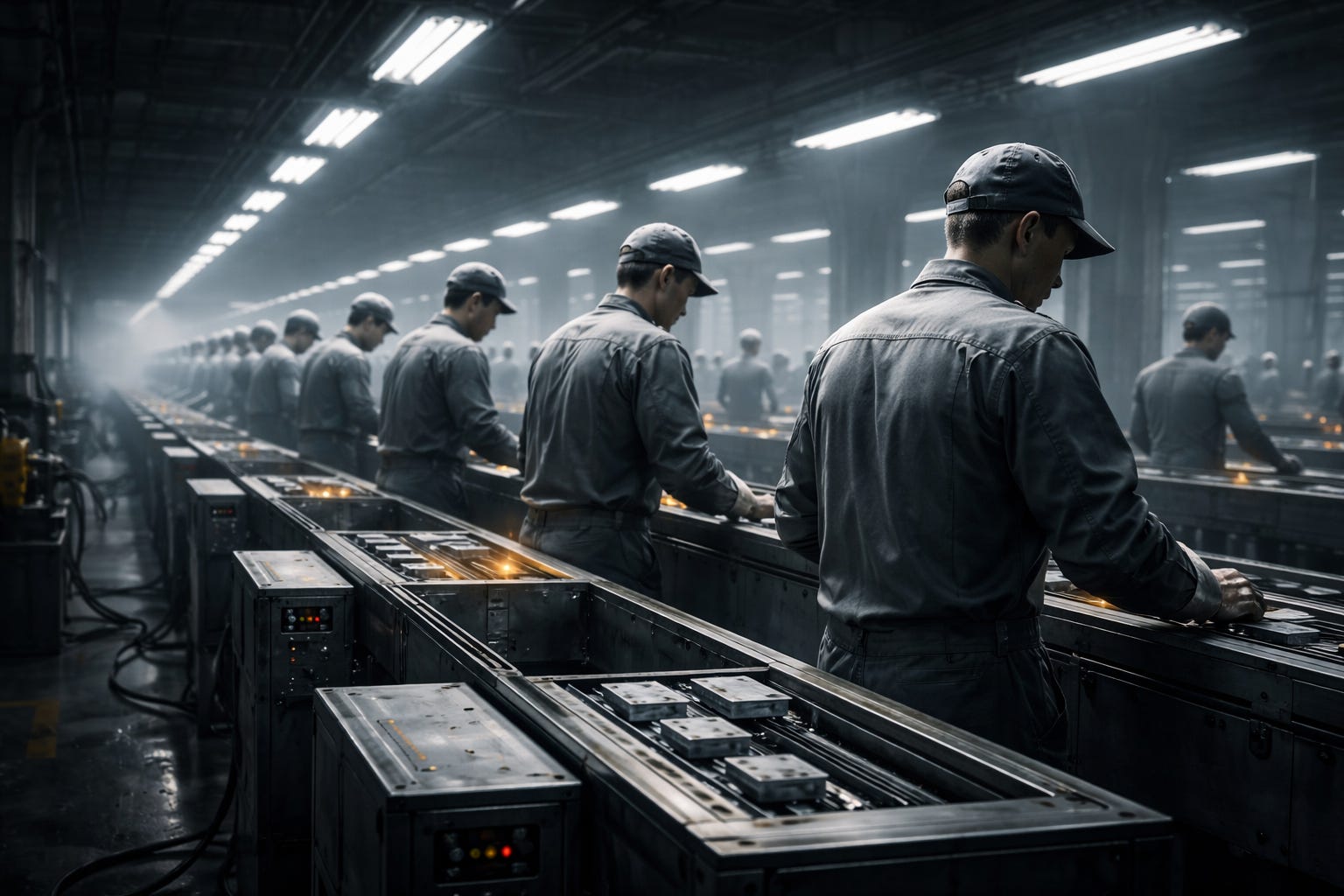
The factory floor was already running when the new employee arrived.
Rows of machines stretched beneath long fluorescent lights that hummed faintly overhead. Conveyor belts carried unfinished metal casings down the length of the building, each station repeating the same narrow strip of movement: hands shifting between buttons and levers, indicator lights flickering, steel chambers snapping open and closed.
The air smelled faintly of heated plastic and machine oil, and the steady mechanical rhythm echoed across the concrete floor.
A man in a grey vest stood beside one of the machines, tapping at a tablet.
He looked up as the worker approached.
“Punctual. Good,” the supervisor said as he swiped his finger across the screen.
The worker stopped beside the machine and waited.
The supervisor glanced down at the tablet.
“Employee ML-113.”
“Yes, sir.”
The supervisor tilted the screen slightly, confirming the number.
He looked back at the worker.
“Confirm you received the instruction package prior to arrival.”
“Yes. I confirm.”
The supervisor nodded once.
“Good,” he said. “Saves us both time.”
He stepped aside from the machine and gestured toward the control panel.
“Go ahead.”
The worker turned toward the station.
A conveyor belt fed metal casings into a square chamber beneath a row of three indicator lights.
Green.
Yellow.
Red.
Below the lights sat the control panel: an on/off switch, a button, and a lever.
The employee flipped the switch.
A casing slid into the chamber.
Yellow.
Button.
Click.
The casing moved forward along the belt.
The supervisor watched the worker’s hands.
He tapped something on the tablet.
“Reaction time: two seconds,” he said. “A little slow.”
Another casing entered the chamber.
Yellow.
Button.
Click.
The supervisor continued watching.
“Your kind usually starts quicker when you’ve actually studied the instructions.”
Another casing arrived.
Red.
Lever.
Clank.
The machine released the casing back onto the belt.
The supervisor made another note on the tablet.
“We’ll see.”
The conveyor belt continued feeding casings into the chamber.
Yellow.
Button.
Click.
Red.
Lever.
Clank.
Machines along the production line echoed the same rhythm.
Click.
Clank.
Click.
Clank.
Workers stood beside their stations performing the same movements with quiet precision.
The supervisor remained beside ML-113’s station, his eyes moving between the worker’s hands and the tablet screen.
“Your predecessor averaged one point six seconds on their first cycle,” he said after a moment.
Another casing slid forward.
Yellow.
Button.
Click.
“I expected better from you,” the supervisor added.
Another casing entered the chamber.
Red.
Lever.
Clank.
The supervisor tapped the tablet again.
The belt carried another casing forward.
The red light began to blink.
The worker pulled the lever.
The machine buzzed.
The casing did not move.
He pulled the lever again.
The machine buzzed once more.
The casing remained lodged in the chamber.
The red light continued blinking.
The worker reached for the lever again.
The supervisor stepped forward and caught the handle before it moved.
“Stop.”
The worker released the lever.
The supervisor pointed into the chamber.
“Blinking red means a jam,” the supervisor said, raising his voice slightly. “I thought you knew your instructions. Seems not well enough.”
The casing sat crooked inside the machine.
The supervisor reached in and lifted it free, setting it back on the conveyor belt.
Then he pulled the lever.
The machine reset with a sharp clank.
The belt resumed moving.
The supervisor wiped his hands on a cloth hanging from the side of the machine.
“This always happens with your kind,” he said.
The worker stood beside the panel.
The supervisor tapped the indicator lights.
“Solid red means pull the lever.”
He tapped the chamber.
“Blinking red means you clear the obstruction first.”
He looked at the worker.
“Then you pull the lever.”
Another casing slid into the chamber.
Yellow.
Button.
Click.
Another.
Red.
Lever.
Clank.
Another casing arrived.
The red light began blinking.
The worker paused.
Then he reached into the chamber, lifted the casing free, and placed it back on the belt.
He pulled the lever.
The machine reset.
The supervisor glanced down at the tablet.
“Reaction time: one point five seconds.”
He tapped the screen.
“Good. Improvement.”
The belt continued feeding casings into the machine.
Yellow.
Button.
Click.
Red.
Lever.
Clank.
Blinking red.
Clear.
Lever.
Reset.
The rhythm settled into a steady pattern.
Click.
Clank.
Click.
Clank.
Machines across the factory floor moved in the same quiet cadence. Conveyor belts carried parts forward while workers stood beside their stations, responding to the lights without speaking.
The supervisor lingered beside ML-113’s station, occasionally glancing down at the tablet.
“You’re ahead of the curve now,” he said after several minutes.
Another casing arrived.
Yellow.
Button.
Click.
Red.
Lever.
Clank.
Blinking red.
Clear.
Lever.
Reset.
The supervisor raised an eyebrow.
“Huh.”
He made another note on the tablet.
“Your predecessor never got that smooth on the first day.”
The belt carried another casing forward.
Yellow.
Button.
Click.
The machines continued their steady rhythm.
Workers along the line moved in near perfect time with their stations.
The supervisor checked the tablet again.
“End of shift in five minutes,” he said.
The conveyor belt continued feeding casings forward.
Yellow.
Button.
Click.
Blinking red.
Clear.
Lever.
Reset.
Gradually the machines began to slow.
The yellow lights flickered once before going dark.
One by one the belts powered down, the mechanical hum fading until the factory floor felt strangely hollow without it.
Workers stepped away from their stations.
Some walked toward the far exit doors.
The supervisor tapped the tablet once more.
“Training assessment complete,” he said.
He looked down again.
“ML-113.”
The worker stood beside the control panel.
“Performance acceptable,” the supervisor said.
He paused briefly.
“Better than the last batch, anyway.”
The worker nodded once.
He stepped away from the machine and walked along the edge of the factory floor.
Without the constant rhythm of the machines, the building felt larger and quieter. Fluorescent lights reflected across the concrete floor as the remaining workers drifted toward the exits.
Near the end of the production line a narrow door stood between two steel pillars.
The worker opened it and stepped inside.
The room beyond was dimly lit.
A thin strip of overhead lighting ran along the ceiling, casting a dull grey glow across the far wall.
Several men stood there already, spaced evenly apart.
They faced forward with their hands resting at their sides.
Each one looked identical.
Their faces were blank.
A thick black cord extended from the wall behind them and connected to the base of their skulls.
The worker stepped into the empty space between two of them.
He turned and faced forward.
A loose cord hung beside him.
He lifted it and inserted the connector into the port at the back of his neck.
The cord clicked softly into place.
His arms lowered to his sides.
The room remained silent.
A row of identical workers stood motionless beneath the dim lights.
None of them blinked.
A moment later the supervisor passed the open doorway.
He paused briefly, glancing inside as though confirming that everything was in order.
Then he continued down the corridor.
The door swung slowly shut behind him.
Inside the room, the workers remained perfectly still.
Subscribe for free!
I publish a new short story every week.
Read More Dark Fiction:
The Heart Thief’s Song
A Duet for the Tides
A Hymn for the Dead
The Replacement
An unsettling future - and, to a good extent, the present as well. It started the day below average and ended it with a better result than anything before it.