
The Replacement
Each time he returned, there was less of him that came back.
I was trying not to piss myself.
That was the truth of it. Not courage. Not duty. Not glory. Just the effort of holding myself together long enough not to make a fool of myself in front of men who looked barely more alive than the dead.
I pressed my hands against my coat, hard enough to hurt, hoping I could force the shaking out of them. It did nothing. The trembling ran through my wrists, my arms, my ribs. I could feel it in my teeth when my jaw clenched.
The trench stank of wet earth, cordite, old smoke, shit, and something sweeter underneath it that made me think of meat left too long in the sun. Mud had worked its way into everything; cuffs, collars, bootlaces, under nails, into the split skin of knuckles. It darkened every face, every sleeve, every strip of bandage.
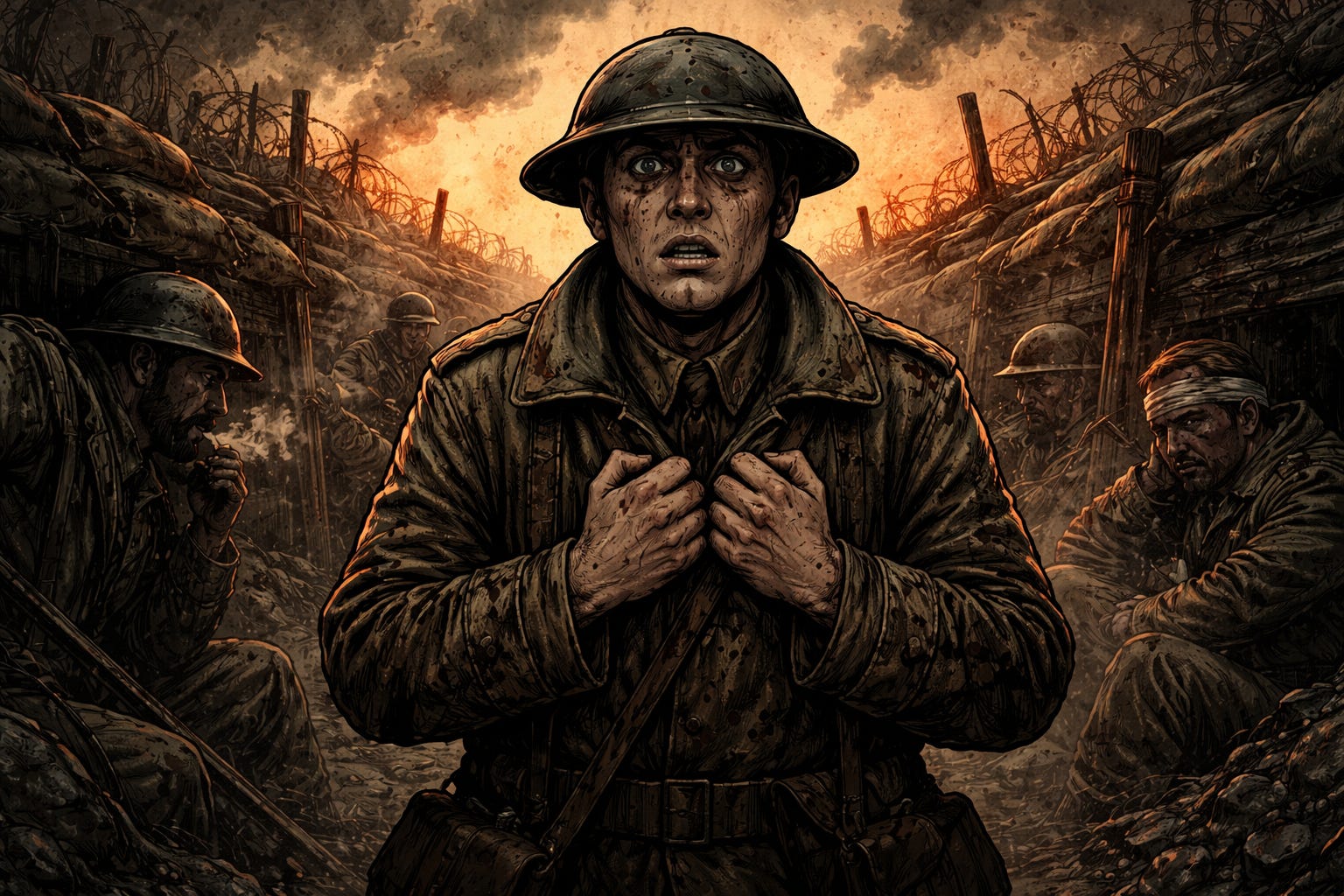
Ahead of me, a man I did not know gripped the ladder with both hands and waited for the whistle.
I stared at the back of his coat because I didn’t want to look anywhere else. If I looked down, I might see what the mud was trying to hide. If I looked up, I might see the sky and remember what waited above us.
The man shifted his grip.
His right hand caught the little light that reached into the trench.
For a second I thought it was only wet mud, slick and black where it had been smeared over the skin. He flexed his fingers and the shine changed with the movement.
I looked away. Fear was making me see things.
The man ahead of him crossed himself.
The one behind me muttered something that might have been a prayer or a curse. At that point they were almost the same thing.
I should not have been there.
The thought had been with me since they put a rifle in my hands. It came back now with such force that I nearly said it aloud.
I shouldn’t be here.
Finally, the whistle blew and the line lurched alive, the high-pitched sound cracking through my chest like lightning.
The man in front of me started climbing, boots thudding against the wooden ladder. Others followed in a jerking rush, vanishing one by one over the trench wall as though the earth itself were swallowing them, while my feet would not move, as if they had somehow gripped themselves into the mud to hold me in place.
Then somebody behind me drove a hand between my shoulders.
“Go!”
The shove pushed me forward.
I climbed.
The world opened into smoke and torn ground and blackened posts of wire. Men were already running through it, bent low, reduced by distance to dark shapes jerking across mud. Gunfire tore the air in a long, unbroken line. Shells burst somewhere ahead and to the left, hurling dirt and smoke upward in black sprays that hung for a moment before collapsing back into the earth.
Then I was over.
The ground was so churned it barely seemed like ground at all. It shifted under every step, slick and sucking, trying to hold me in place. I ran because everyone around me ran. There was no choice in it, no room for fear or courage, only forward movement.
Men were shouting, the shape of their words lost in the gunfire.
A body went down to my right. Another pitched forward ahead of me and slid into the mud on his face. Someone screamed in a high, cracked voice that sounded too young, too much like my own.
The noise was disorienting, coming from every direction at once and never stopping. Gunfire. Shellfire. Men shouting. Men screaming. I wanted to close my eyes, to lie down, to be anywhere else.
But I kept moving.
The wire was ahead somewhere. I could see the broken posts through the smoke.
If I could make it there—
Something hit my left shoulder.
It was not like being cut or burned or even struck. It was impact, pure and terrible, as though a giant hand had taken hold of me and slammed all its force through one side of my body. My rifle flew from my grip. My legs disappeared beneath me. The ground struck my knees, then my face, then all of me at once.
I did not understand what had happened until I tried to push myself up and my left arm would not answer.
The battle continued around me.
I lay in the mud and heard men running past, heard gunfire overhead. My shoulder felt not painful at first, but wrong, blank and absent and enormous all at once. I turned my head and saw only smoke and boots and churned earth.
I opened my mouth to shout.
Mud filled it.
I spat and coughed and tried again, but whatever came out was lost under the roar of battle.
Boots passed close to my face.
No one stopped.
The sky above me looked pale and distant, almost peaceful behind the smoke.
Then it vanished.
Relief struck me first.
I was alive. At least, I hoped I was.
The light pressed against my eyes with a flat, constant brightness that did not flicker like fire or shift like daylight through smoke. It felt unnatural even before I opened them.
When I did, the ceiling above me was white and smooth and seamless.
No beams. No canvas. No stains.
The air smelled like nothing.
Not clean linen. Not medicine. Not blood.
Nothing at all.
As though every scent had been stripped from it.
After the trench, the absence itself felt frightening.
A faint mechanical hum lingered somewhere beyond the bed, steady enough to disappear when I tried to focus on it.
I pushed myself upright, too easily. Only then I remembered my left arm.
I looked for a sleeve, a bandage, blood, anything familiar.
Instead, I found a metal limb rested where my arm should have been.
Steel caught the white light in dark, clean planes. The shoulder joint was narrow and precise, fitted into me with such exactness that the seam itself was more terrible than a wound would have been. Plates overlapped at the upper arm. Cables, or something like tendons. shifted faintly at the elbow.
The hand looked almost human.
The fingers opened, one after the other.
I felt it.
Not the familiar movement of flesh and bone, but something cold, something strange. Like the motion happened first, and the sensation arrived afterward to tell me it had.
I jerked back.
This isn’t mine.
The thought struck so hard it seemed to shake through me.
The fingers moved again.
Fingers. Not mine.
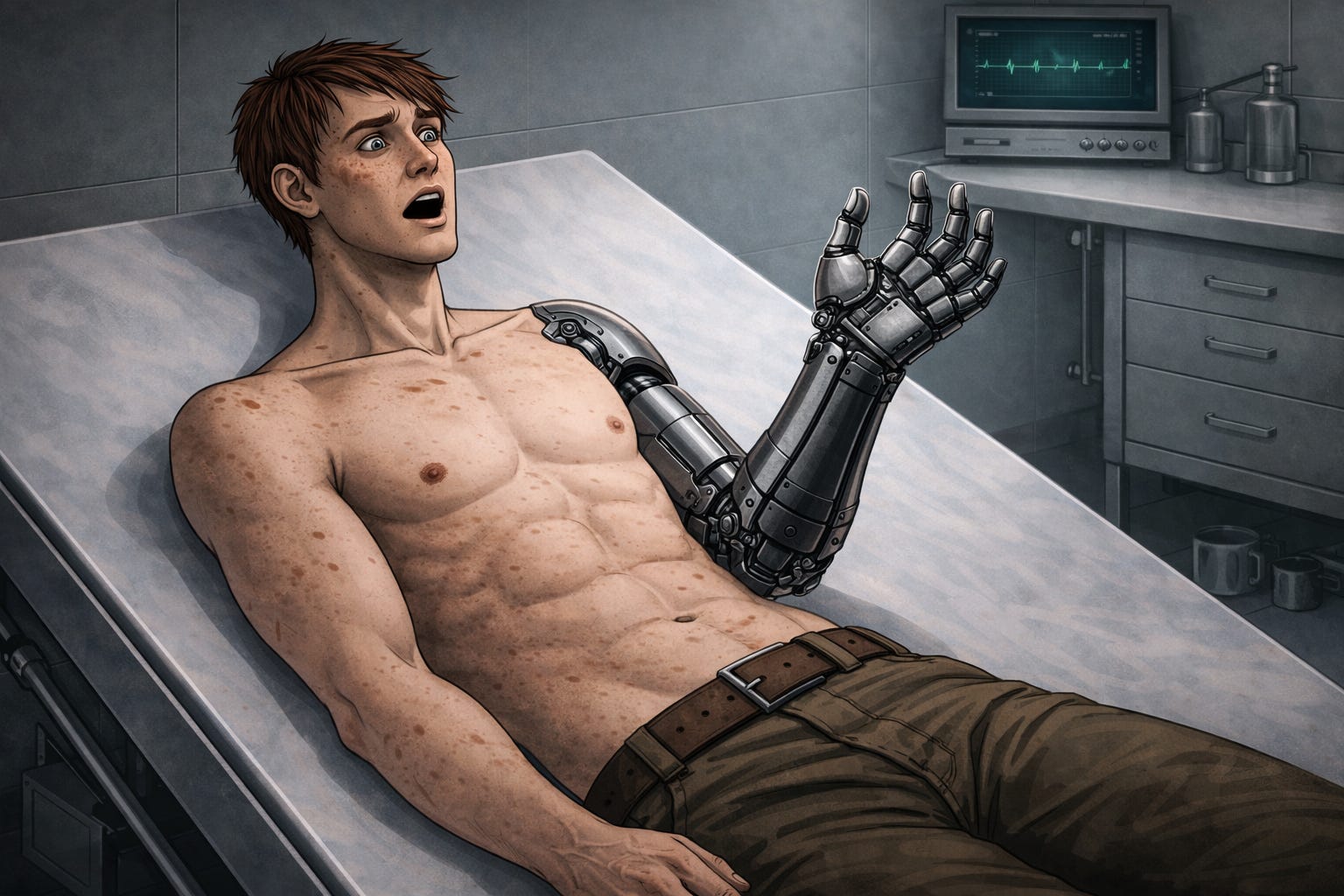
A voice spoke to my right.
“Responsive. Good.”
I turned so fast I nearly fell from the bed.
A man stood beside a narrow table, a slim panel in his hand. He wore pale clothing that fit close to the body and showed no sign of dirt, wear, or haste.
Nothing about him belonged to mud or gunfire.
He did not look at me.
He looked at the panel.
“What is this?” I heard myself say. My voice sounded small.
“You sustained critical damage to the limb,” he said. “It has been replaced.”
“Replaced?” I looked from him to the arm and back again.
“Functionality has been restored,” He tapped on the screen in front of him. “You are combat-capable.”
My chest tightened.
“No… I can’t go back out there.”
Images flashed; mud, screaming, bodies.
I stared at the arm.
The dark metal caught the light in the same hard way that other hand in the trench had.
I had seen it.
I had looked away.
“I don’t want this,” I said again, quieter now.
The man stepped aside.
“Stand.”
I pulled myself up, gripping the bedframe.
Behind him, a corridor stretched out under the same flat white light.
“You will return to your unit,” he said. “Redeployment is scheduled.”
Redeployment.
As though I were equipment.
Gunfire echoed faintly somewhere far away.
I stepped forward.
The second time I went over the top, I was still afraid.
But the fear had company now.
The arm moved too well.
That was what I noticed first. When I slipped, it corrected faster than I could think. When I hit the ground, it took my weight without shaking. When I grabbed the rifle, my grip settled instantly. I kept looking at it as I ran, half expecting it to lag behind me like dead weight or go suddenly mad and wrench itself the wrong way.
The battlefield was still chaos. Men still fell. Smoke still hid the ground until you were nearly on top of it. The wire still waited ahead like a threat from a bad dream. Nothing out there had changed.
A shell burst ahead and threw dirt against my face. I hit the mud by instinct and came up again before I had fully realized I’d gone down. The movement had been too quick, too smooth.
The man beside me did not get up.
I saw his leg bent under him at the wrong angle. Saw his mouth open in a shape that might have been a shout. Then I was past him.
I made it farther this time before they hit me again.
Shrapnel through the shin. A sharp burst of pain, the crack of bone. The world tipping. Mud rising. Darkness.
When I woke in the white room, the leg from my right knee down was metal.
I saw it immediately and I was sick on the floor.
Nobody rushed to help. Nobody even seemed surprised. I knelt there under the bright light, shaking and spitting bitterness onto a spotless floor, and a woman in pale clothing stood nearby with her hands folded behind her back until I was finished.
“Adaptation discomfort is common,” she said.
I looked up at her, wiping my mouth with the back of my hand.
“Discomfort?”
My voice sounded wrong to me then. Hoarse and weak and far away.
She glanced down at a panel of her own.
“Neurological rejection remains within acceptable parameters.”
“I’m not rejecting it,” I said. “I’m terrified.”
She made a note.
I think that was when I first understood that they did not care about the difference.
They sent me back.
The next few cycles blur together in places, but not all of them.
Some details stand out too clearly.
The climb over the ladder with my heart hammering so hard I thought it might burst before a bullet could reach it.
The bright, awful moment of relief when I made it halfway across open ground untouched.
The bullet that struck my side.
The white room.
The smooth, expressionless face of a man telling me damage to the ribs and left lung had been resolved.
Resolved.
As if he were talking about paperwork.
After that, breathing changed.
I noticed it in the trench before the next whistle. Men around me gulped air through fear and cold and damp, but my own breathing moved in and out with a steadiness that made me feel sick. I tried to force it faster. It corrected itself.
I still felt fear then. Deeply. Enough to taste it.
But the fear no longer owned all of me.
I began to see others more clearly after that. Not just mud and bandages and hollow cheeks. Other things.
A jaw that caught the light too sharply when a man turned his head. A strip of metal visible above a collar where skin should have met fabric. Fingers too precise in their movement. Eyes that did not blink often enough.
I had not imagined that first hand.
The trenches were full of men like me.
Or men on their way to becoming something like me.
I tried, after that, not to be hit.
I tried with a desperation that went beyond surviving. I learned the rhythm of shelling. Learned where the ground dipped enough to hide in. Learned how to move lower, faster, more efficiently. I followed shouted orders before they had finished leaving an officer’s mouth. I crossed ground that should have killed me and reached places I had no right to reach.
I became better at war.
That was its own horror.
A boy in an enemy trench raised his rifle at me and I shot him before I had fully registered his face; smooth, young like mine. My metal hand did not shake. My body did not lurch afterward the way it once might have. The gun kicked. The boy fell. I moved on.
The replacements made me faster. Stronger. Harder to kill. Every change made the next survival more likely. Every survival increased the chance of another injury, another return to the light, another piece taken and improved.
I was not being healed.
I was being kept in service.
The six time they sent me back with the left side of my jaw rebuilt after a shell fragment tore through it. The seventh time there was something done to my eye. After that, I could see too clearly from that side. Mud droplets on coats ten yards away, wire glinting through smoke, the faint twitch of movement before a man broke from cover.
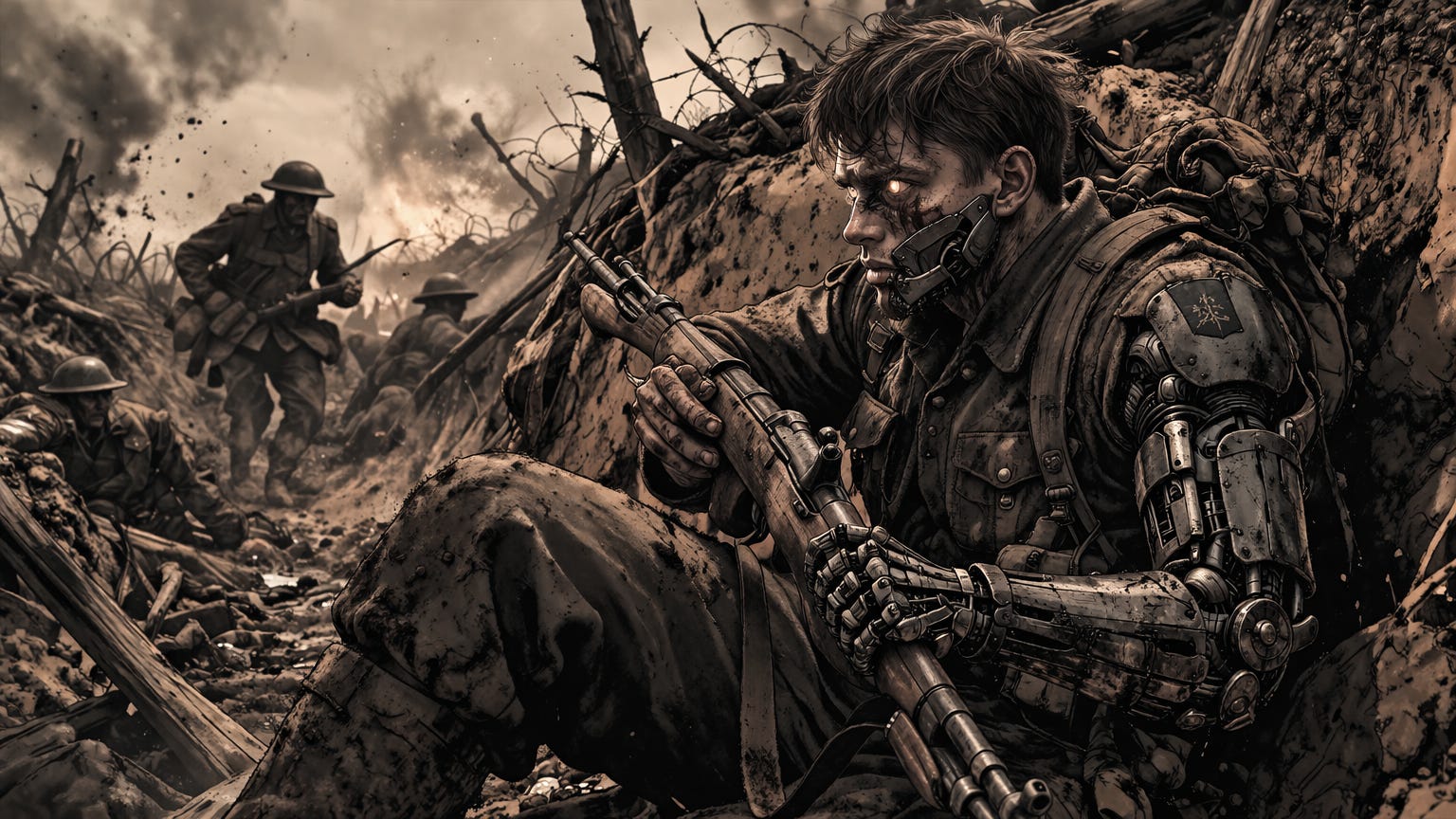
I began to dread the white room. That fear did not replace the battlefield all at once. It crept in.
The whistle would blow and terror would seize me as before, but threaded through it now came another thought, cold and clear beneath the panic:
Don’t get hit.
Do not go back there.
The bright room. The clean air. The measured voices. The terrible absence of blood. The feeling of being replaced, one piece at a time.
The next time I climbed the ladder, I did it because I wanted, with a desperation I cannot properly describe, to make it to the other side whole.
I moved low through smoke and mud, every part of me focused on avoiding impact. My body responded instantly. Faster than ever. A shell hole yawned open ahead and I cleared it cleanly. Machine-gun fire stitched the mud to my left and I changed course before the sound had fully reached me. Wire loomed, and I found the gap without searching.
For a few shining seconds, I thought I might do it.
Then something struck me and drove me backwards into the earth.
Pain flashed white. Then numbness spread down my right side in a wave so sudden it felt planned.
I knew before I blacked out what they would take next.
“No,” I said into the mud.
The guns swallowed it.
The white room was waiting.
A man stood nearby, panel in hand.
“Spinal reinforcement successful,” he said. “Stand.”
“No.”
The word surprised both of us.
“You are cleared for redeployment.”
“I said no.” I pushed myself up on one elbow. “I’m done. I’m done! I won’t go back.”
Something sharpened in his attention. “Resistance response observed.” He made a note on the panel and then stepped closer. His hand rose toward the base of my skull.
I tried to pull away but something inside me seized. My spine locked. My legs found the floor. My body rose.
Panic struck me so hard it made the room tilt.
“No,” I said again. Louder. “No, stop—”
His fingers rested lightly at the back of my neck, where flesh gave way to something I had not wanted to imagine. Metal answered metal beneath the skin.
“Motor override functional,” he said.
I was standing.
My racing heart steadied. My body stood still as a statue.
I tried to move my arm and could not. Tried to turn away and failed. Every command I sent into myself vanished somewhere before it reached its destination.
Panic. Terror. Rage.
None of them mattered.
I remember the corridor after that; white light, smooth walls, the sound of gunfire waiting far off as though the world itself had been reduced to a distant machine.
I remember trying to hold onto the word I.
It didn’t mean anything anymore.
The soldier stood in the trench among the others.
Mud slicked the duckboards. Men shifted shoulder to shoulder beneath the earthworks, checking rifles, tightening straps, bowing their heads as the whistle waited somewhere ahead. Faces were grey with exhaustion and dirt. Hands trembled. Breath smoked faintly in the cold.
The soldier did not tremble.
Reinforced spine held posture upright. Left arm operational. Right leg operational. Respiratory efficiency maintained. Ocular response improved. Motor override confirmed.
The whistle blew.
The line moved.
Men climbed the ladders in a staggered rush, boots scraping wood, bodies vanishing over the lip into smoke and gunfire. The soldier climbed with them.
Open ground stretched ahead in torn bands of mud and wire.
Incoming fire registered from the right. Adjusted trajectory calculated. Forward movement maintained.
A shell burst to the left and threw dirt over three advancing men. Two fell. One rose again. The soldier altered course by half a stride and continued.
No hesitation.
Wire ahead. Gap identified.
The soldier crossed it.
An enemy rifleman appeared through smoke at the far parapet. Target acquired. Engagement immediate. Threat neutralized.
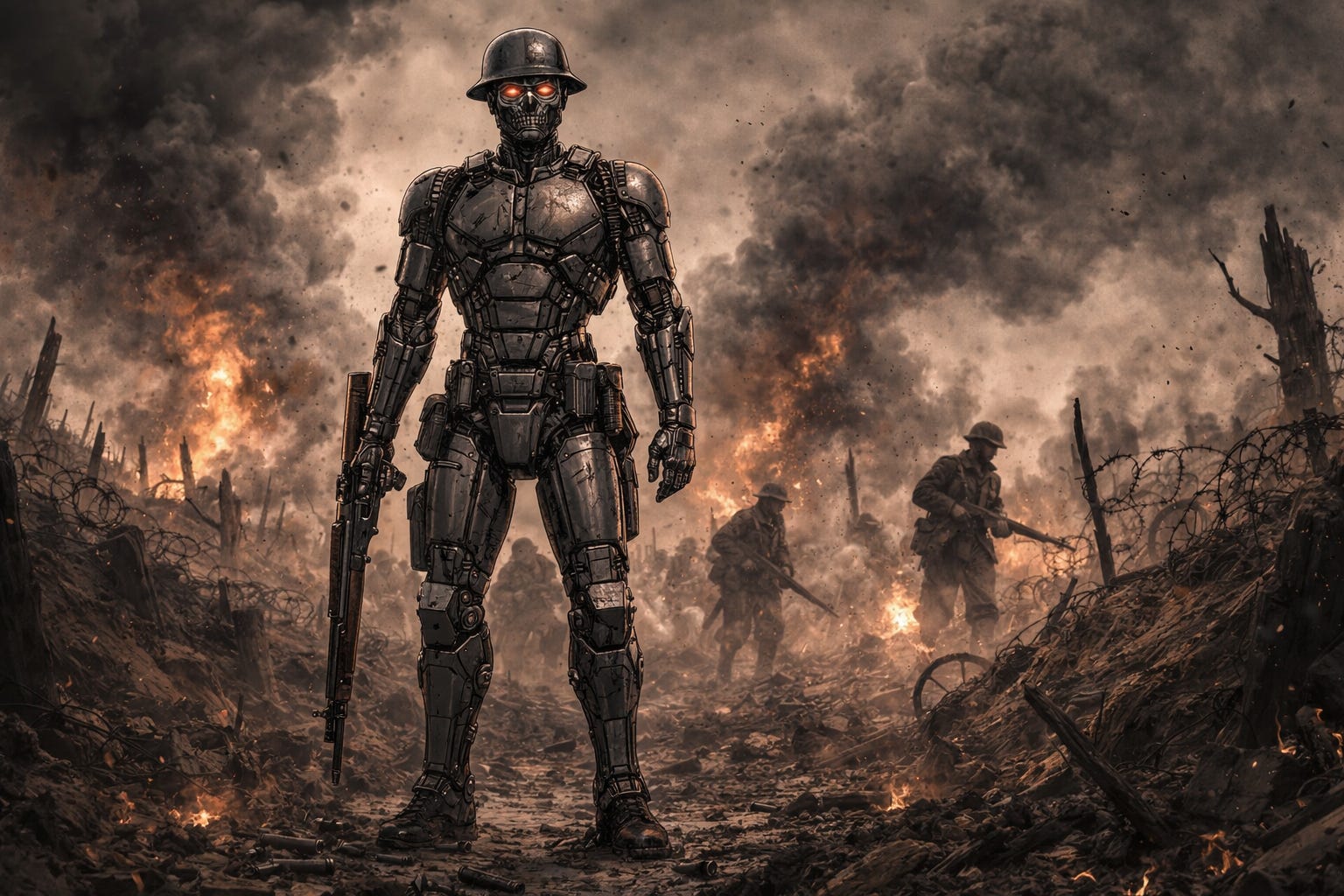
Designation unchanged.
Combat efficiency improved.
The soldier advanced.
Subscribe for free!
I publish a new short story every week.
Read More Dark Fiction:
The Heart Thief’s Song
A Duet for the Tides
A Hymn for the Dead
Machine Learning
This is such a fantastic read, Sylvia; what a metaphor for the mess our species has found itself in (again) as of late. Have you ever read the Mabinogion? The Welsh epics and the Cauldron Born?
Very much enjoyed this. Thank you.